KIMT’s Miniature Thermal Cycling Micromodules Enable Per-Well Control for Next-Generation PCR and NGS Library Prep
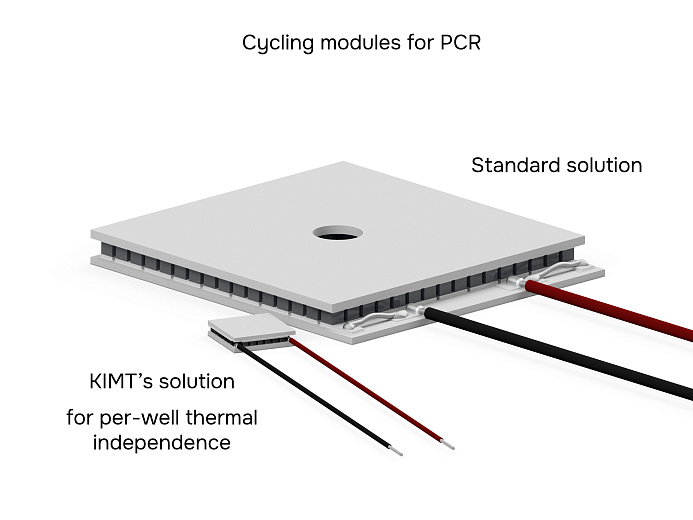
KIMT, a manufacturer of thermoelectric coolers (TECs), introduces a new class of miniature thermal cycling micromodules designed for integration into advanced PCR and NGS library preparation instruments. With ceramic footprints as small as 4×4 mm and thermoelectric pellets below 1 mm², these micromodules enable instrument developers to implement per-well thermal control—a capability previously unattainable with conventional large-format TECs (≥20×20 mm).
Conventional PCR thermal cyclers rely on large-format TECs that cycle all 48–96 wells simultaneously. This forces instrument designers to accept fundamental trade-offs: fixed cycle numbers for all samples, limited ability to compensate for well-to-well variation, and no mechanism to individually optimize amplification for samples with differing input concentrations or amplification efficiencies. These limitations directly impact data quality in NGS applications such as microbiome profiling, where over-amplification generates chimeras and skews species representation, while under-amplification leads to sample dropouts.
KIMT’s miniature thermal cycling micromodules fundamentally change what is possible in thermal cycler architecture:
· Per-well thermal independence – with footprints down to 4×4 mm, multiple micromodules can be arranged to match standard 96- or 384-well plate formats, enabling each well to be heated and cooled according to its own profile.
· High-speed response – heating and cooling rates up to 20°C/sec at the module level, allowing instrument developers to implement rapid cycling protocols without compromising thermal uniformity.
· Exceptional durability – validated for >500,000 thermal cycles (40°C base, +20/+100°C cold side, 30-second cycle), ensuring reliable operation in high-throughput environments.
Enabling Advanced Applications
The availability of miniature, independently controllable thermal cycling modules opens new possibilities for PCR and NGS library preparation. Instrument developers can now implement:
· Individual well optimization – each reaction can be cycled according to its own amplification kinetics, eliminating the need for a one-size-fits-all cycle count.
· Real-time adaptive protocols – combined with optical monitoring, per-well control enables functions such as Auto-Normalization, where each sample is cycled until it reaches a target amplification threshold, preventing both over- and under-amplification.
This architecture has already been successfully deployed in next-generation PCR platforms.
KIMT’s miniature thermal cycling micromodules are now available for OEM integration. They are offered in multiple form factors (ceramic sizes from 4×4 mm) with customizable pellet configurations to support different well densities and thermal performance requirements. For technical specifications, integration support and evaluation samples contact KIMT.