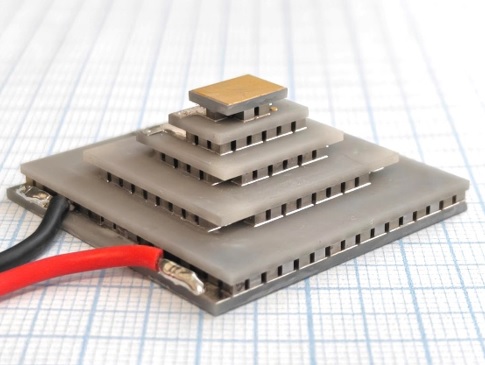
In modern infrared (IR) detection systems, the quality of the received signal directly depends on the thermal stability of the photosensitive element. The task is clear: the lower the detector temperature, the lower the thermal noise and the higher the detectivity of the device. However, reaching operating temperatures in the range of 170–190 K while removing a heat load of more than 300 mW has long remained a serious technical challenge for cooling system developers.
KIMT specialists have successfully solved this problem – a five‑stage thermoelectric cooler (TEC) has been developed and tested, ensuring stable operation of a photodetector at temperatures as low as ‑100 °C (173 K). Below we describe the development process and the tests that the new module underwent.
Why Extreme Cooling Is Necessary
Infrared detectors operating in the mid‑ and far‑IR ranges are critically sensitive to their own thermal radiation. The noise of the photosensitive matrix increases with temperature, reducing the signal‑to‑noise ratio and the detectivity of the device. The optimal balance between sensitivity and reliability lies in the temperature range – from 170–190 K and lower.
The most compact, reliable and energy‑efficient way to achieve such temperatures is multistage thermoelectric cooling. Thermoelectric coolers offer a number of undeniable advantages:
- No moving parts or refrigerants.
- High reliability and long service life (up to 300,000 hours).
- Fast response and the ability to stabilize the temperature of the photosensitive area with an accuracy of 0.01 °C.
- Compact size and low weight.
However, reaching temperatures below ‑80 °C under a significant heat load is beyond the capability of standard three‑ or four‑stage solutions. In most known studies, the heat load on the cold side did not exceed 100–150 mW. In our project, the requirement was to remove more than 300 mW – a task previously considered extremely challenging for thermoelectric systems.
Key Objective: Design and Manufacture
The initial technical requirements were as follows:
- Cold side temperature – not higher than 173 K (‑100 °C).
- Heat load – 310 mW.
- Hot side temperature (heat sink) – not higher than 298 K (+25 °C).
- Operating environment – vacuum.
These figures meant that the developers had to create a unique TEC capable of providing a temperature difference of at least 125 K (ΔT ≈ 125 K) while removing a significant amount of heat – several times higher than in previously considered analogues. For comparison, the results of recent scientific studies show that achieving a temperature difference of about 124 K for a five‑stage TEC is a major technical milestone comparable to the world level.
The KIMT team approached this non‑trivial task comprehensively, breaking the development into several key stages.
Stage 1: Selection and Fabrication of Thermoelectric Material
Any efficient TEC starts with a high‑quality thermoelectric material. For such a wide temperature range (from room temperature down to ‑100 °C), a material with the maximum figure of merit ZT across the entire range is required.
KIMT specialists produced a specialized extruded thermoelectric material based on bismuth telluride, optimized for low‑temperature operation and possessing a number of critically important properties:
- High thermoelectric efficiency in the designed temperature range (from 300 K to 170 K).
- Improved mechanical characteristics.
Unlike crystals obtained by directional crystallization (zone melting), the extruded polycrystalline material has higher mechanical strength. This property is extremely important for multistage modules – it is the mechanical reliability of the legs at the temperature gradient boundary that often becomes the bottleneck limiting the product’s lifetime. The compressive strength of such material can reach 189 MPa, and the flexural strength 139 MPa, which guarantees the possibility of micromachining elements with dimensions of about 100 µm.
Stage 2: Optimisation Calculation of the Design
The next step was to find the optimal geometry and configuration of the five‑stage module by means of mathematical modelling. The aim of the calculation: to minimise power consumption while achieving the specified temperatures and removing 310 mW of heat.
Since each stage of the TEC creates its own temperature difference and the same current flows through all stages, the problem of finding the best number ratio of the thermoelements in each stage is non‑trivial. Such a multi‑parameter optimization can reduce power consumption by tens of percent compared to empirically selected designs, which is especially important for on‑board and autonomous systems.
As a result, a solution was found that ensures the minimum possible power consumption of the module under the given operating conditions.
Stage 3: Modelling and Prototyping
Based on the optimization calculation, the following were carried out:
- Detailed mathematical modelling of the module (calculation of standard and operating parameters).
- Fabrication of prototypes according to the obtained topology.
After assembly, KIMT specialists performed precision measurements of the actual characteristics of the modules under vacuum and at a hot side temperature of 298 K (room temperature). Two main dependencies were measured:
- Achievable temperature difference (ΔT) as a function of supply current under the specified heat load of 310 mW.
- Voltage‑current characteristic of the module.
Stage 4: Comparison of Calculations and Experiment
The final step of the design phase was to compare the characteristics predicted by the mathematical model with the real ones obtained during prototype testing.
The discrepancy between the calculated and experimental data was within the measurement uncertainty, confirming the high accuracy of the engineering calculation methods used at KIMT.
Reliability Tests
However, simply creating a module that reaches ‑100 °C is not enough. It must maintain its properties under harsh operating conditions for thousands of hours.
The prototypes underwent environmental tests according to the requirements of international standards MIL‑STD‑883L and Telcordia GR‑468‑CORE. In particular, the following were carried out:
- Temperature cycling (simulating repeated on‑off cycles).
- High‑temperature storage (accelerated ageing tests).
Compliance with these stringent standards means: KIMT modules remain operational under cyclic temperature loads typical of real‑world operation and have a predictable long‑term lifetime.
Conclusions
The developed five‑stage TEC fully accomplished the set task. The module can be recommended for cooling IR detectors over a wide temperature range, down to 170 K, and is capable of operating under a high thermal load (more than 300 mW), which significantly expands the functionality of the final optoelectronic devices and increases their detectivity.
All work was performed by KIMT engineers at every stage – from concept development and theoretical calculations to prototype fabrication and certification according to international reliability standards.
The development of new generations of photodetectors requires innovative cooling systems. KIMT has all the necessary technological base to create TECs that provide cryogenic temperatures with the highest accuracy and long lifetime. For more information about customizing solutions for specific needs, please contact the KIMT development department.